
Learning to Be Human Through the Resilience of Weeds
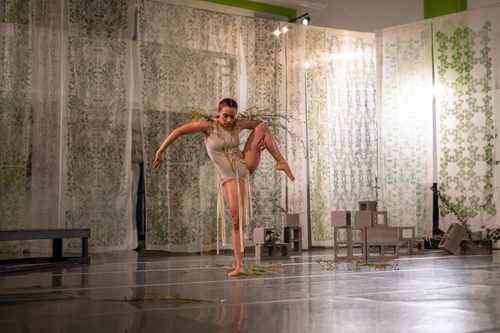
In garden vernacular, weeds are the unwanted subjects of manicured, curated landscapes. But in their discardment, their beauty is often forgotten, as is their sheer resilience and commitment to survival. On November 6 and 7 at the Houston Met Dance Center, Houston-based Mexican/Costa Rican dance artist Paty Lorena Solórzano premiered La Maleza: Weeds as Teachers, a work two years in the making and a study in patience, growth, and metered, thoughtful change.
Much of the evening’s wonderment was a product of cross-disciplinary artist Nicole Sara Simpkins’ expansive installation. Her towering silkscreen prints hang down from the Houston Met’s second story, creating enchanting visuals of weeds interspersed with scenes of manmade structures. In one corner, the outlines of oil rigs mesh with a pattern that could be either waves or a flock of unknown birds. Simpkin’s visual world is composed of mild mustards, gentle limes, and splashes of demure periwinkle, creating a harmony between the brash lines of human industry and the circular, organic shapes of the natural world.
La Maleza began with Solórzano descending the tiered steps of the Houston Met’s central studio-turned-performance space in a sculptural costume by Simpkins, a bushel of assorted tall weeds jutting out from the back and creating a sort of halo effect that was not only splendid to see, but evocative to hear in all of its rustling whimsy. Solórzano took a prone position to begin the opening section, “Slow Emergence.” Here her limbs pushed upward in fits, as if pushing through an unseen resistance to grow into odd, asymmetrical positions.
There is a visible use of breath here in this section to create tightly bound shapes, unique balances, and intricate entanglements. Solórzano is illustrating the complex, nonlinear growth of weeds as they often must navigate manmade obstacles and inhospitable terrain. Eventually the weeds are cut loose from Solórzano’s costume, and she fills the space with expansive movement sequences composed of rushing, scooping, and flapping of the arms.
The frenetic energy of these sequences builds to the moving “Uprooted,” a scenario that sees Solórzano gathering the discarded weeds and forming a makeshift bouquet that she sets near the audience. She lets go of the base of the weeds, and the untethered bundle collapses in on itself. A beat later, Solórzano collapses, her limbs rearranging themselves into a pile where they fall. She repeats this twice in different directions and points in the space. This simple sequence is a beautiful visual metaphor, as people, like weeds, need roots, an anchor, a clear and understood history to stand tall.
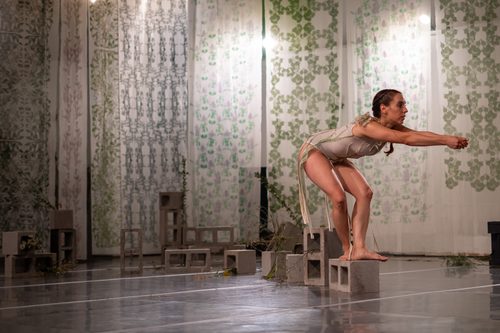
In “The Root of the Problem,” Solórzano works her way to a pile of cinderblocks, placing her weeds through the openings and creating a familiar image of nature battling manmade material. She positions herself atop the pile of cinderblocks, and then begins shifting the pile piece by piece. The cement pieces are balanced on her head, carried on her shoulders, and cradled in her arms, before each is mindfully placed in a spot that allows a forward trajectory.
I could feel the passage of time in this section, the effort it takes to create forward-moving momentum. The work of moving the weight of the cinderblocks recalled the work of maneuvering and crafting a life, and the uncertainties of that tenuous journey. There is a motif here that I found particularly effective, that of a hand gesture that reminded me of sprinkling seeds onto the earth, accented by a flick of the wrist. It is a delicate punctuation in a sojourn that requires effort and grit.
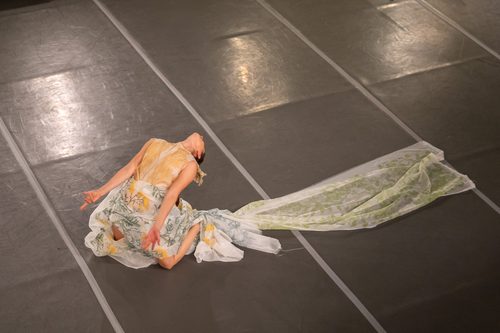
The second act sees Solórzano shift perspective, as the choreography takes on a more human valence. In “Now is the Time/Orange,” she slips beneath one of Simpkins’ silkscreens, using the material to slide and writhe across the floor to “Orange Blossoms” by Jolie Holland. There is a sense of internal struggle here, a tension between sitting in a frustrating circumstance and the comfort of being confined. Another powerful motif emerges, that of one arm outstretched, palm cupped, and fingers reaching upward. The constant high release evokes a sense of spiritual mindfulness, the body open to possibility while remaining anchored.
The conclusion of the Holland track marks a return to Anthony Almendarez’s live accompaniment, in this particular moment a mournful dirge on trumpet. His score is a remarkable achievement throughout the production, filled with grand and eloquent themes, while also appropriately curious and exploratory during the softer moments. His work is so rich and textured that it could stand on its own merits, but offers a satisfying marriage of music and movement created in tandem and with similar, thoughtful intention.
La Maleza concludes with an improvisational ensemble score in which dancers emerge from behind the silkscreens and become one of the weed-teachers alluded to in the work’s title. They arrange themselves on the ground, bushels of weeds extending from different body parts as Solórzano expresses in poetic lines the lessons gleaned from the unwanted. “Listening is a form of prayer,” she says. “Weeds taught me to be human.” Solórzano gathers the original bouquet of weeds and moves to a mound of dirt in the far corner, placing herself in the mound. This time neither the weeds or herself collapse, the lights lowering on the image of living things firmly rooted in the earth.
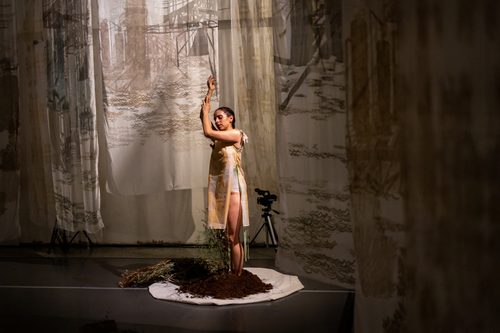
This is the third fully produced evening-length work that I have seen in this particular space, and it was by far the most successful. The work’s muted design palette made for a striking effect against the wash of bright, warm light, and Simpkins’ large-scale silkscreens created both an intimate atmosphere while also emphasizing the sheer size of the space. I have seen iterations of this project over the past two years, and the duration speaks to the work’s themes of patience, resilience, and quiet resistance.
Watching a fully realized dance work has always felt like a balm for the soul to me, but witnessing a masterwork is a true invigorating of the spirit. La Maleza is one of those works. Through this personal investigation, Solórzano reveals fundamental truths about our current condition. Growth and change takes time. Patience is needed to maneuver that time.
And by rooting down and listening to the quietest of thoughts, a life filled with humanity will slowly emerge.


Recent Comments