
Review: Overcoming and Becoming
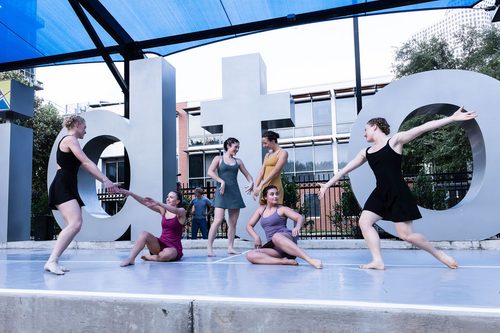
Project Overcoming and Becoming can heal wounds, old and new. This show created a space where the audience could self-insert into a story and find compassion, not comparison. Creators Keeley Dunnam and Sarah Hill have started something that I feel is ambitious and precious. While Project Overcoming and Becoming is still in its beginning stages, it is fueled by obvious heart.
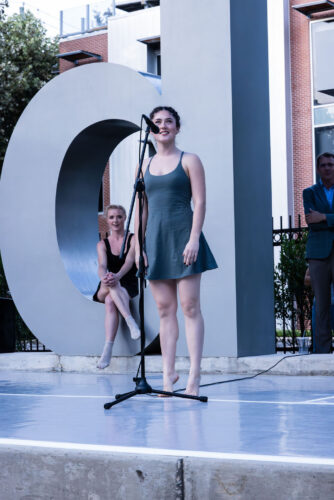
The show, supported in part by the Midtown Micro Grant, is set in three parts: a duet, a solo, and an ensemble, with a poetry reading between each section. Project Overcoming and Becoming was introduced by the project’s sound mixer/master and poetry reader Jason O’Donohue, followed by Dunnam and Hill, who described the work as “about the ways we push, pull, overcome, and continue becoming through the experiences that shape us.”
The dancing sequences were set to recordings of anonymous, vulnerable confessions and testimonies of personal growth, resilience, and strength accompanied by a background of soft piano. Because this performance was hosted at Bagby Park, at times the audio had to compete with outside noise and traffic, but the essence of the messages were still communicated and felt, nonetheless.
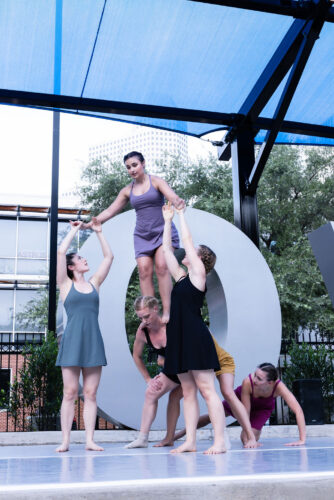
The choreographic elements and tools utilized in this project for the most part stayed faithful to the themes of overcoming and becoming. For example, the use of repetition was particularly effective in showing how nonlinear the road to healing and recovery can be. The consistent use of rising and falling, lifting and carrying, and the sharing and exchanging of weight appropriately tied the movement to the stories we heard. These motifs were found in all three sections of the work.
Dunnam and Hill introduced and concluded their project as a team with such sincerity and generosity that their mutual love, respect, and genuine connection to each other as artists and collaborators could not be missed. While this dynamic did not necessarily translate onstage, not for a moment should that be mistaken for a lack of ability or commitment to the project. In this reviewer’s opinion, it is due to a miscalculation of choreographic priorities. As mentioned previously, the choreography presented a variety of motifs related to the cycles of growth and grief, which were successful choices for this type of project. At the same time, while visually stunning, some of the acrobatic lifts and balances, which required some notable setup and time to dismount, felt like an interruption to the work, interfering with the structural integrity and flow of the project. I am not suggesting a complete removal, only consideration of what the greatest priorities for the project are. The groundwork is already there. Think about how to redirect that necessary trust and communication found within the acrobatic partnerings into a demonstrable connection between the dancers inside of the storytelling. This will be the difference between the audience watching a performance and experiencing it.
That being said, there were some significant moments I experienced inside of this work, my favorite being the solo/ensemble support section. The audio here was of a dancer describing their difficult journey through a lupus diagnosis, memories with Grandma, and a beloved nickname, “Butterfly”, which we are told is the symbol for the lupus community, and a nickname given before the diagnosis. Much like how the nickname came long before the illness, the abstraction of butterfly wings in the choreography became a movement motif far before the butterfly elements to the story were even revealed. This made the moment the choreography met its source, its origin and inspiration, so breathtaking to behold. Sarah Hill, the soloist, was captivating in her embodiment of the character with such intensity that I cannot imagine it ever being danced by anyone else. The spoken words were not in competition with the choreography: here, everything moved together as one. Even when the ensemble dancers began to trickle in and ripple out as symbolic and literal support to the soloist, I was reminded of a kaleidoscope of butterflies, and in that moment, I too, felt less alone.
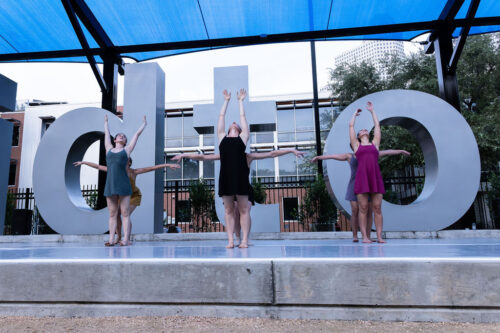
The ambitious and precious something that Keeley Dunnam and Sarah Hill have created is a thing that reminds us all of why we love and need art, and that is to feel connected. Even in its elementary stages, this project has accomplished what I think it set out to do: present the world with a physical way of reminding us all that the things we think separate us the most from each other, our deepest pains and regrets and darkest moments, are really the things that unite us the most. With a simple project title, a vision, and a collection of community-sourced stories, Project Overcoming and Becoming showed us how much we need community without ever saying the actual words. An invitation at the end of the show to continue sharing and connecting through experiences of overcoming and becoming built a new community that day in Bagby Park. While quiet and thoughtful, it should not be underestimated: any community of artists brave enough to challenge the stigma of disability and invisible illness, especially in the dance industry, is one with the ability to outlast, overcome, and become something wholly remarkable – full of courage, color, and such great heights. I await Dunnam and Hill’s next installation of their project, and you should, too.


Recent Comments